
Last Updated: November 24, 2026
Quick Summary
CBD treats may help some dogs with anxiety and joint discomfort, but the evidence is early and uneven. Anxiety has more supportive research than joint pain, so the two concerns should be weighed separately. Discuss cbd treats with your veterinarian before starting any product.
- Anxiety evidence is early and supportive; joint-pain evidence is weakest and mostly anecdotal.
- A 2021 Frontiers study found CBD treats did not affect adult dogs' daily activity.
- Check each treat's milligrams per chew, batch-specific COA, and THC level.
- Keep a two-to-four week log of behavior and mobility before judging any change.
- Change one variable at a time, and disclose all medications to your veterinarian first.
Table of Contents
- Can CBD Treats Help Dogs With Anxiety and Joint Discomfort?
- Signs of Anxiety in Dogs and When Joint Pain Is the Cause
- CBD Dog Treats vs. Oils: Which Format Works Better?
- What the Research Shows About CBD for Dogs
- CBD Safety and Efficacy for Dogs: Evidence, Limits, and Side Effects
- Why Vet-Approved CBD for Dogs Starts With Your Veterinarian
- Choosing Your Next Step for a Calmer, More Comfortable Dog
- Frequently Asked Questions
Can CBD Treats Help Dogs With Anxiety and Joint Discomfort?
CBD treats may help some dogs with anxiety and joint discomfort, but the evidence is early and uneven. The available research is more nuanced than most product pages suggest. A 2020 study of CBD-containing treats and dogs' responses to fear-inducing stimuli looked at behavior under stress, but the published result we reviewed does not report a clear numerical outcome.
Two concerns often show up together in the same dog. A nervous dog may pace, pant or hide, while a dog with stiff joints may hesitate on stairs or resist jumping into the car. Owners sometimes assume both problems share one cause, but they often do not. Treating them as separate questions makes the decision much clearer.
The short answer for most households: CBD treats are a reasonable thing to discuss with your veterinarian, not a replacement for a proper diagnosis. Start with the vet visit, then decide whether a treat-based approach fits your dog.
Signs of Anxiety in Dogs and When Joint Pain Is the Cause
Anxiety and pain can look alike from across the room. If your dog struggles on the stairs, guidance on whether joint supplements help everyday mobility explains what to look for. Trembling, lip licking, a tucked tail and reluctance to move may point to fear, pain, or both. The behavior alone rarely tells you which.
Watch for patterns rather than single moments. Anxiety tends to flare around specific triggers such as thunderstorms, fireworks, car rides or visitors. Joint discomfort tends to show up with movement: slow rising from a bed, a reluctance to climb stairs, or a stiff gait after a nap.
A simple home check helps. Note when the behavior happens, what the dog was doing just before, and whether it improves with rest. Bring those notes to your veterinarian, because a vet can examine the joints and rule out pain before attributing the behavior to nerves.
CBD Dog Treats vs. Oils: Which Format Works Better?
Treats and oils deliver the same compound in different ways, and the best format depends on your dog and your routine. If product labels confuse you, how hemp oil differs from CBD for dogs breaks down each ingredient.

!A calm senior golden retriever sitting beside its owner in a sunlit kitchen, the owner offering a soft beef-flavored chew from an open palm
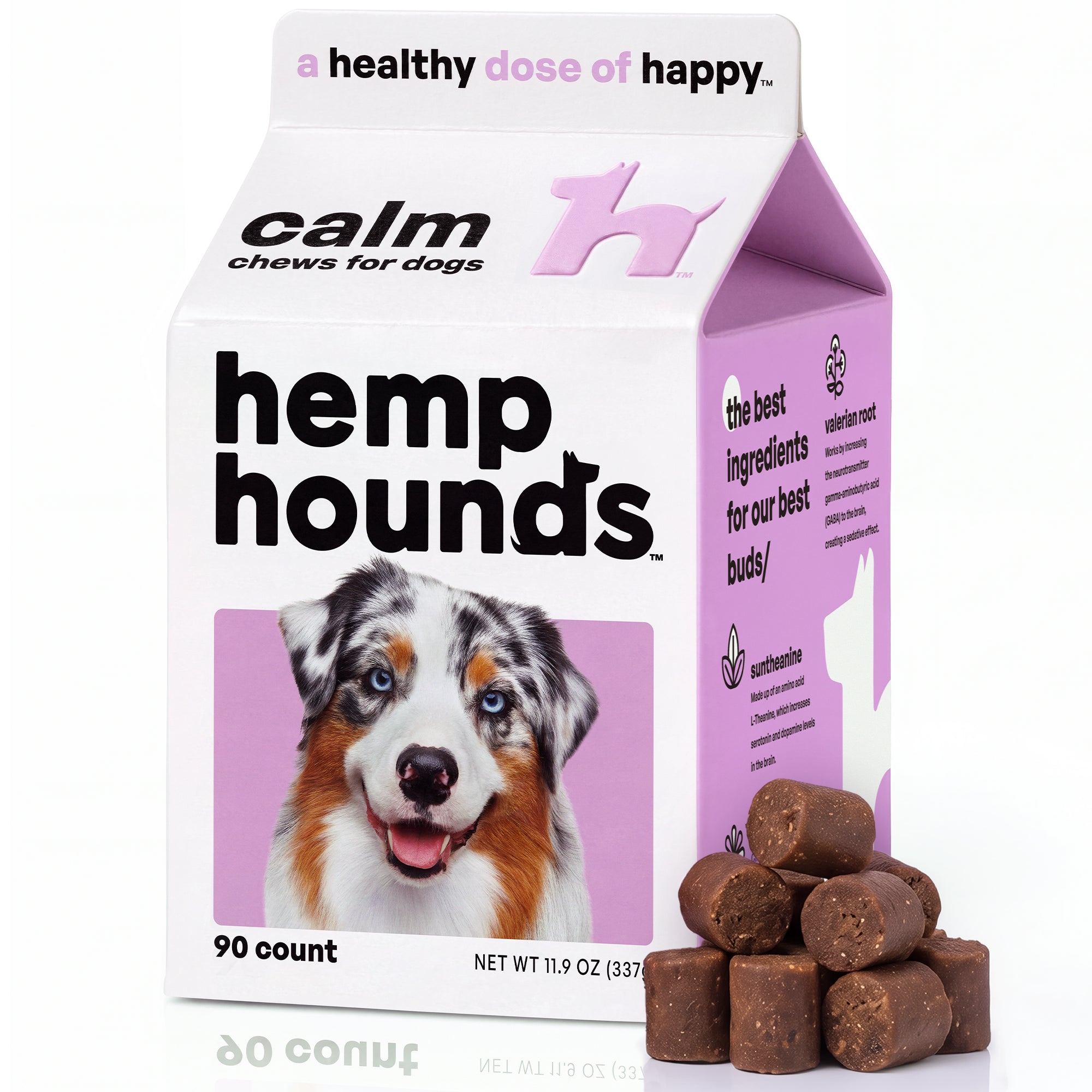
Our Calm chews use a beef liver flavor, which many dogs accept readily, and they are plastic-free and melatonin-free. The Hip / Joint chews follow the same format for dogs with mobility concerns.
| Format | Best for | Main drawback |
|---|---|---|
| Soft chews | Routine daily dosing, picky eaters who accept treats | Less precise dose adjustment |
| Oils and drops | Fine dose changes under vet guidance | Taste resistance, measuring errors |
What the Research Shows About CBD for Dogs
The research base is thin, and it is not equally thin across the two concerns. Separating what canine studies show for anxiety from what they show for joint discomfort is the single most useful thing an owner can do before buying a treat.
Anxiety and stress behavior. The most-cited canine work is a small crossover study of CBD-rich oil in dogs exposed to fear-inducing stimuli, published in 2020. The authors reported changes in some stress-related behaviors, but the sample was small, the dose was fixed, and the result does not translate into a universal calming effect. A separate trial of CBD chews given before a stressful event reported that 83% of dogs showed a decrease in stress- or anxiety-related behaviors, per Cornell's Riney Canine Health Center summary, a promising number, but one drawn from a single small study without a large replication behind it. A 2025 study by Flint and colleagues reported a mild stress-reducing effect from treats combining CBD, L-tryptophan and alpha-casozepine, and the authors themselves called for further research. Read together, the anxiety evidence is best described as early and supportive, not established. To understand how these herbs fit alongside CBD, see what adaptogens can do daily for dogs.
Joint discomfort and mobility. This is where the evidence is weakest. Most of what owners read about CBD for arthritis comes from owner-reported surveys, product marketing, and extrapolation from human osteoarthritis trials, not from controlled canine studies measuring lameness, gait, or pain scores. A 2021 study in Frontiers in Veterinary Science found that CBD-containing treats did not affect adult dogs' daily activity, which is a useful reminder that a change owners feel they see is not the same as a measured mobility improvement. No large, placebo-controlled canine trial we reviewed establishes that CBD treats reduce joint pain or slow osteoarthritis progression.
What the numbers can and cannot tell you. Survey data points in the same direction as the marketing: Honest Paws reports that among dog owners who use CBD, 28% use it for anxiety and stress and 17% for pain, though the survey methodology is not clearly published. That tells you what owners are trying, not what works. A common pattern in the literature is that calming effects show up in short-term behavioral measures while joint benefits remain largely anecdotal.
Why the gap matters for a dog with both problems. If your dog is anxious and stiff, the anxiety side has more (if still early) evidence behind it, and the joint side has more established non-CBD options, weight management, exercise adjustment, and veterinarian-prescribed pain care. That asymmetry should shape the conversation with your vet: CBD is a reasonable adjunct to discuss for stress behavior, but it should not displace proven joint care.
Watch out: a product page that cites a single study as proof of both calming and joint relief is blending two very different evidence bases, treat that as a marketing signal, not a clinical one.
Share of CBD-using dog owners by reason for use
CBD Safety and Efficacy for Dogs: Evidence, Limits, and Side Effects
Efficacy and safety are separate questions, and for a dog with both anxiety and joint discomfort the safety side deserves careful attention. The FDA has not determined that CBD is safe as a food additive, dietary supplement, or treatment for pets, and quality and labeling vary widely across the market (the FDA). That regulatory gap is exactly why the owner, not the brand, has to do the vetting.
A label and testing checklist. Before buying any treat, look for the following, in this order:
- CBD amount per treat, not per container. A bag that says "300 mg CBD" tells you nothing if it holds 30 chews; you need milligrams per chew to compare products and to follow a vet's starting dose.
- Batch-specific certificate of analysis (COA). The COA should match the lot number on the package and come from an independent lab, not the manufacturer's own facility. A COA that is undated, unbatchable, or missing the cannabinoid panel is not useful.
- THC limit. Look for a stated THC result, ideally at or below 0.3% on a dry-weight basis, and confirm the COA reports it. Dogs are more sensitive to THC than people, and a product that does not disclose THC content is a risk you cannot measure.
- Contaminant panel. The COA should screen for heavy metals, pesticides, residual solvents, and microbials. A cannabinoid-only COA leaves the rest of the batch unverified.
- Ingredient transparency. Full ingredient list, no proprietary blends hiding the active amount, and disclosure of complementary compounds such as L-tryptophan, alpha-casozepine, glucosamine, or chondroitin if they are included.
Side effects to monitor. Reported effects in dogs include drowsiness, digestive upset, and changes in appetite. Less commonly, owners report wobbliness or increased thirst. Keep a simple log of the dog's behavior, appetite, stool, and gait for the first two weeks so you can distinguish a real change from normal day-to-day variation.
Drug interactions and lab monitoring. Dogs on other medications, especially those processed by the liver, such as some seizure medications, pain medications, and steroids, may face interactions, so disclose every supplement and prescription to your veterinarian before starting. CBD can also affect how other drugs are metabolized, which is one reason a vet-led trial beats a self-directed one.
Contraindications and red flags. Do not start a CBD treat without veterinary input if the dog is pregnant or nursing, is scheduled for surgery, has uncontrolled liver or kidney disease, or is already on multiple medications. Stop and call your vet if you see vomiting that persists, marked lethargy, incoordination, or a sudden change in appetite.
A cautious starting and monitoring protocol. There is no established universal dose for dogs, so treat any number you see online as a starting point for a conversation, not a prescription. A common veterinarian-led approach is to begin at the low end of the product's suggested range, give it at the same time each day, record behavior and mobility in a simple log, and reassess with the vet after two to four weeks before changing anything. Change one variable at a time so you can tell what, if anything, is working.
Watch out: a treat that combines CBD with other active compounds (L-tryptophan, alpha-casozepine, glucosamine) makes it impossible to attribute a change, or a side effect, to any single ingredient, so start with one product and one variable.
Why Vet-Approved CBD for Dogs Starts With Your Veterinarian
"Vet-approved" is a phrase to examine carefully. Cornell's veterinary guidance advises consulting a veterinarian about how CBD might affect a dog's health and asking which products or brands they recommend, according to Cornell University's Riney Canine Health Center guidance on CBD.
Bring a short list to your appointment: the dog's age, weight, current medications, the behaviors you have noticed, and the product labels you are considering. Ask whether the vet can examine the joints, whether a trial period makes sense, and what signs would mean you should stop.
Hemp Hounds formulas are described as veterinarian-supported, and your own vet's review remains essential.
Choosing Your Next Step for a Calmer, More Comfortable Dog
If your dog's anxiety or stiffness is disrupting daily life, start with a veterinary exam, then talk through whether a CBD treat fits. Keep a simple log of behavior and mobility for two to four weeks so you can judge any change honestly.
If you decide to try a chew, begin with the Calm chew at $32.99, or the Hip / Joint chew at $32.99. Choose one product at a time so you can tell what, if anything, is working.
Frequently Asked Questions
Is CBD good for dogs with joint issues?
The research on CBD for joint discomfort in dogs is still limited. Owner surveys report that some dogs taking CBD are given it for pain and arthritis. Those reports describe what owners do, not proven results. Joint discomfort can have several causes, so a veterinarian should examine the dog before CBD is added.
Are there any CBD treats that can help dogs with anxiety?
Results vary, and severe anxiety should be evaluated by a veterinarian. Hemp Hounds Calm chews are a melatonin-free option at $32.99.
What are the signs of extreme anxiety in dogs?
Signs of extreme anxiety in dogs can include pacing, trembling, panting when not hot, excessive barking or whining, destructive chewing, hiding, house soiling, and attempts to escape. Some dogs drool, lick themselves repeatedly, or refuse food during stressful events. Pain can produce similar behavior, such as irritability when touched or reluctance to climb stairs, so a physical exam is important. If the behavior is sudden, worsening, or interferes with daily life, contact your veterinarian promptly.
When should I talk to a veterinarian about my dog's anxiety or joint discomfort?
Talk to your veterinarian before giving your dog CBD, especially if your dog takes prescription medication, has liver or kidney disease, or is pregnant or nursing. Cornell's Riney Canine Health Center advises consulting a veterinarian about how CBD might affect a dog's health and asking which brands or products they recommend. Schedule a visit sooner if your dog shows new limping, reduced activity, or anxiety that is getting worse, since these can signal a condition that needs treatment.
